
Filing a lawsuit against a person in Saudi Arabia is the legal procedure that enables you to claim your rights and respond to infringements in accordance with the approved judicial systems. Whether the matter involves a financial claim, a civil dispute, or moral harm, knowing the correct steps and the statutory requirements is the foundation of a successful case.
You can file the lawsuit before the court or electronically through the “Najiz” portal by completing the statement of claim and attaching the documents, then following up on the hearings until the judgment is issued and enforced. This article explains clearly everything you need to submit your claim in a legally correct manner that ensures its acceptance.
Were your rights taken from you, and you fear the procedures? Don’t let your right go to waste. The “Saudi Legal Consultation Directory” keeps you safe and immediately connects you with a select group of litigation experts to take on the task of filing your lawsuit professionally and safeguarding your rights.
Or continue reading the article to learn the conditions for accepting the claim first
جدول المحتويات
Legal steps for filing a lawsuit against a person
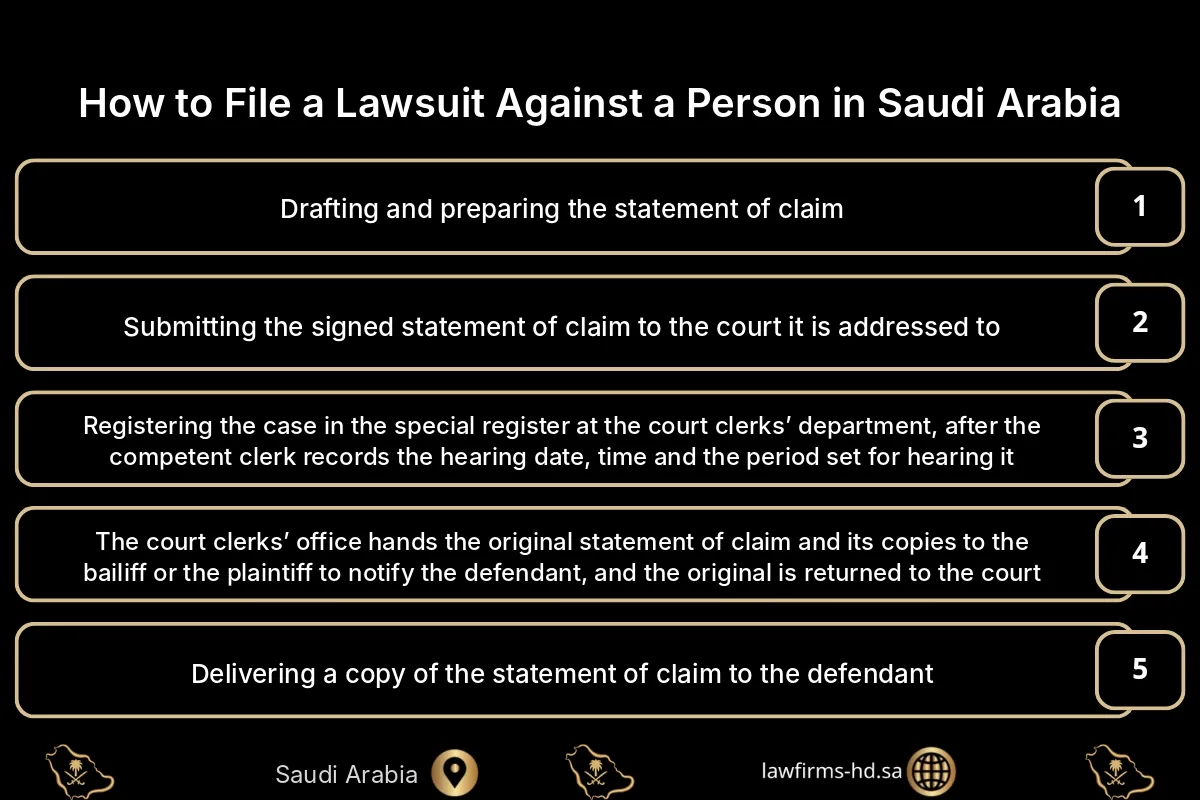
Some people may be forced to file a lawsuit against another person after suffering material or moral harm, which makes it important to know the correct legal method of filing a claim that safeguards rights and ensures procedural soundness. The legal steps for filing a lawsuit against a person in Saudi Arabia:
- Attempting an amicable settlement (optional in some cases): In many cases, especially civil and rights-based claims, it is preferable first to try to resolve the dispute amicably through negotiation or mediation, to avoid the length and cost of litigation.
- Applying to the competent body for settlement (where mandatory): Some cases, such as personal status cases or labor disputes, require first applying to a settlement body before resorting to court (for example: labor offices, reconciliation centers, or the Taradhi platform).
- Determining the type of case and the competent court: The case must be classified (civil; criminal, such as filing a fraud lawsuit; commercial; personal status; etc.), and the court with local and subject-matter jurisdiction must be identified, such as filing a lawsuit in the administrative court, in accordance with the Law of Procedure Before Sharia Courts (Article 31, Law of Procedure Before Sharia Courts, in force from 1445/08/01 AH)
- Preparing the statement of claim electronically: Through the “Najiz” portal, the plaintiff or their legal representative prepares the statement of claim, including:
- Details of the plaintiff and the defendant.
- The subject of the claim and the legal grounds.
- Clear requests (for example: compensation, a judgment of obligation, etc.).
- Supporting documents (contracts, witnesses, correspondence, reports, etc.).
- Filing the lawsuit via the Najiz portal: The lawsuit is filed electronically on the platform after logging in, then:
- Select “Statement of Claim.”
- Select the type of case.
- Fill in the data and attach the documents.
- Send the request to the competent court.
- Paying the case fees (if any): Some cases require payment of judicial fees in accordance with the Judicial Fees Law (Article 3, Judicial Fees Law, effective 1443/01/01 AH), while personal status and labor cases are usually exempt from fees.
- Notifying the defendant: The court notifies the defendant of the statement of claim and the hearing date, electronically through “Absher” or by other legal means.
- Attending hearings and submitting memoranda: The parties must attend the hearings (in person or via video call), with the possibility of submitting reply memoranda or defenses during the hearings. It is advisable to engage a lawyer to ensure the strength of the legal argument.
- Issuance of the first-instance judgment: After the pleadings conclude, the court issues its first-instance judgment and it is served on both parties. It may be challenged within the specified statutory period.
- Challenging the judgment (appeal/cassation): If a party does not accept the judgment, they may submit an objection memorandum to the Court of Appeal within 30 days of notification (Article 178, Law of Procedure Before Sharia Courts).
- Enforcing the judgment (if final): After the judgment becomes final, a request for its enforcement can be submitted electronically through the “Najiz” portal, and the Execution Court will take the legal measures to compel the judgment debtor to comply.
Not sure how to start your case? Our team of lawyers at the Saudi Legal Consultation Directory platform walks you through it step by step so you can file a procedurally valid lawsuit through “Najiz.” Click the WhatsApp button now to begin your legal pleading with confidence.
Procedures for filing a lawsuit electronically through Najiz
With the development of judicial services in Saudi Arabia, it has become possible to carry out the procedures for filing a lawsuit electronically through Najiz in simple steps, without having to visit the courts in person. Here is how to file a lawsuit electronically through Najiz:
- Logging in to the Najiz portal: Start by logging in to the Najiz portal using your “National Single Sign-On (Nafath)” or “Absher” account. This ensures secure access to the Ministry of Justice services linked to your digital identity.
- Selecting the “Statement of Claim” service: From the main menu, go to “Judicial Services,” then choose:
- “Statement of Claim” → “File a New Lawsuit.”
- Choose the type of case (civil, labor, personal status, commercial…) according to the subject of the dispute.
- Filling in the details of the parties to the case: Enter the following information accurately:
- Details of the plaintiff (or the legal representative).
- Details of the defendant (name, ID number, national address).
- Contact information. If the defendant’s location cannot be determined, notification may be requested through newspapers or other legal means.
- Identifying the competent court: The system automatically displays the court with local and subject-matter jurisdiction based on the type of case and the place of residence of the parties, in accordance with the Law of Procedure Before Sharia Courts (Article 30 and the following articles)
- Explaining the subject of the case and detailing the requests: In this step, you are asked to:
- Write a summary of the facts.
- Specify the claims precisely (for example: compensation, contract rescission, an order to pay…).
- State the legal or Sharia basis for the claim where possible. This step is necessary to draft a complete legal claim.
- Attaching the documents supporting the case: Attach electronic copies (PDF) of all evidence and documents, such as:
- Contracts.
- Invoices or receipts.
- Official records or correspondence.
- The national ID or the Sharia power of attorney if you are representing another party.
- Submitting the request and awaiting judicial review: After reviewing all the data and attachments:
- Click “Submit.”
- You receive a request number and a confirmation of submission.
- The request is transferred electronically to the competent court.
- Receiving a notice of acceptance of the case and the hearing date: You receive a message on your mobile phone and by email as soon as the case is accepted, with the details of the first hearing. The defendant is also notified automatically through the approved means of notification.
- Attending the hearing electronically or in person: It is determined whether the hearing will be remote (via “Najiz” or “Microsoft Teams”) or in person at the court. You must attend the hearing on time and submit any required documents or responses during it.
- Following up on the case electronically through Najiz: You can follow the progress of the case from your account on the Najiz portal, where the following are displayed to you:
- Hearing decisions.
- Exchanged memoranda.
- The date of the next hearing.
- The status of the case (ongoing – rejected – judgment issued…).
- Receiving the judgment electronically and objecting if necessary: After the first-instance judgment is issued, you are notified of it electronically, and you are given the period to object electronically (appeal) from the same platform, within the statutory period specified in the law.
It should be noted here that it is necessary to consult a lawyer specialized in the subject of the case to help prepare the claim, draft it, attach the evidence and proofs, and ensure it is filed with the competent court in accordance with the legal procedures that support it and increase its chances of acceptance and success.
Conditions for filing a lawsuit against a person under Saudi law
For a complaint or lawsuit to be admissible both formally and substantively, a number of conditions and requirements must be met when filing a lawsuit, most notably:
- The standing requirement: The lawsuit must be brought by a party with standing against a party with standing. Since the subject of the lawsuit is a claim to a right that has been infringed or is threatened with infringement, the lawsuit must be brought by the person who claims this right for themselves in their personal capacity, against the person who infringed their right or threatened to do so, also in their personal capacity, and no one else.
- The interest requirement: There must be an interest in filing the lawsuit, whether by obtaining and achieving a benefit for the complainant or by repelling an imminent harm whose near occurrence is indicated by recognized indications.
Accordingly, this interest must be existing, present and lawful, based on a legal right that should be established or protected, or the interest may be potential as stipulated in paragraph (1) of Article 3 of the Law of Procedure Before Sharia Courts. - The legal capacity requirement: The parties to the legal complaint, whether the plaintiff or the defendant, must have legal capacity, meaning they are of sound mind and have reached the age of majority.
- The jurisdiction requirement: The lawsuit filed must fall within the jurisdiction of the court to which it is submitted (filing a lawsuit in the commercial court).
- Limitation period: The requirement to file the lawsuit within the time period set by law in the Saudi regulations must be observed; it varies according to the type of case, whether civil, commercial, criminal or personal status.
- Conditions relating to the claimed right, which are:
- It must be lawful and not contrary to the rules of Islamic Sharia and the regulations in force in the Kingdom.
- It must be due and established.
- It must not have been previously adjudicated, in application of the principle of res judicata.
- No legal procedure may have been agreed upon regarding the claimed right, such as arbitration, because an arbitration agreement between the parties prevents the right holder from resorting to the courts to protect this right or to repel harm from it.
- No settlement may have taken place between the parties regarding the claimed right.
Let our lawyers at the Saudi Legal Consultation Directory platform for legal consultations in Saudi Arabia review your file and make sure that every supporting document is attached on time. Send your case file via WhatsApp now and get an immediate legal review.
Sample statement of claim
To ensure that the lawsuit is accepted by the court, it is necessary to prepare a statement of claim in a correct form that complies with the requirements of Saudi laws, as the statement of claim is the basic document on which the examination of the case is based.
A ready-to-use sample statement of claim:
- Court details:
The General / Criminal / Personal Status Court in the city of: ……….. - Plaintiff’s personal details:
Name: ………………………………….
National ID: …………………………
Mobile number: …………………………….
Email: ………………………
National address: ………………………… - Defendant’s personal details:
Name: ………………………………….
National ID (if available): ………………
Address: ………………………………..
Mobile number (if available): ………………….. - Subject of the claim:
…………………………………………….
(Example: a financial claim due to an unpaid lease contract) - Facts of the claim:
On the day ………. corresponding to …………, an agreement was made between me and the defendant on ………………, pursuant to ……………. (a contract / a receipt / a documented oral agreement / correspondence).
On ………… the defendant breached his obligation to …………….. despite my demanding it from him orally and in writing, which caused me material/moral harm. - Requests:
I request from the esteemed court the following:- Order the defendant to pay the sum of (………… Saudi riyals).
- Order him to bear all judicial fees and expenses.
- Issue an enforceable judgment.
- Legal grounds:
I rely in my claim on:- Article ………. of the …………. Law
- The jurisprudential/Sharia maxim: “Harm is to be removed”
- Judicial principles issued by the Ministry of Justice (if any)
- Attachments:
- A copy of the national ID.
- A copy of the contract or the document supporting the claim.
- Copies of correspondence or notices.
- Any additional supporting documents.
Plaintiff’s name: ……………………………
Date: ………… / ………… / 14 AH
Signature: ……………………………….
Read about: how to file a lawsuit against a sole proprietorship and file a lawsuit against a company in Saudi Arabia.
What happens after filing a lawsuit against a person in Saudi Arabia?
Many people ask: what happens after filing a lawsuit against a person in Saudi Arabia? And what stages does the case go through until the judgment is issued and enforced:
- Court review of the statement of claim: After the lawsuit is filed electronically through the “Najiz” portal, the competent court reviews the data and attachments to ensure that they satisfy the statutory requirements.
- Registering the case and assigning its number: Once the requirements are met, the case is officially registered in the court’s records, and both the plaintiff and the defendant are given a reference number for the case, through which they can follow the procedures electronically.
- Formal notification of the defendant: The court notifies the defendant of the statement of claim and the hearing date, and electronic notification through the “Absher” platform is the first approved means in accordance with the Law of Procedure Before Sharia Courts.
- Holding the first hearing: At the scheduled time, the first hearing is held (remotely or in person) and the parties are asked to present their defenses or respond to the allegations.
- Exchange of memoranda and replies: The parties may be given a period to submit written memoranda or supporting documents, known as “written replies and pleadings,” which is done through the Najiz platform without the need to visit the court in person.
- Pronouncement of the first-instance judgment: After the pleadings are completed, the court issues its judgment, and it is served on both parties electronically.
- Period for objecting to the judgment: If the judgment is not final, the aggrieved party has the right to object to it within the statutory period (usually 30 days), by submitting an “objection memorandum” through Najiz to the Court of Appeal.
- Issuance of the final (conclusive) judgment: If no objection is made within the period, or if the Court of Appeal upholds the judgment, the judgment becomes “final” and “enforceable,” and it is an enforcement instrument that can be submitted to the Execution Court.
- Submitting a request to enforce the judgment: Through Najiz, an enforcement request can be filed electronically with the final judgment attached, and the Execution Court begins taking measures such as: freezing bank accounts, attaching property, and imposing a travel ban.
- Recovering the right or ending the dispute: The case ends with the actual enforcement of the judgment or a reconciliation between the parties during the enforcement stage, and the reconciliation can be proven through an official record.
Your legal rights when filing a lawsuit against a person
It is important to be aware of your legal rights when filing a lawsuit against a person, so that you can pursue the case within the legal frameworks and ensure that your rights are fully respected before the judicial authorities. Your legal rights when filing a lawsuit against a person in Saudi Arabia:
- The right to litigate before the competent court: You have the right to resort to the judiciary to claim your right, and the court is obliged to hear the case in accordance with the Law of Procedure Before Sharia Courts (Article 1).
- The right to legal representation: You may represent yourself before the court, or appoint a licensed lawyer to file the lawsuit, attend the hearings and defend you.
- The right to submit evidence and documents: You are allowed to submit whatever supports your case, such as documents, witnesses, reports, or any lawful means of proof that strengthens your legal position.
- The right to object to the judgment: If a first-instance judgment is issued that is not satisfactory to you, you have the right to object to it within the statutory period (30 days), through appeal or cassation, depending on the type of case.
- The right to enforce the judgment after winning it: Once the final judgment is issued, you can submit an electronic enforcement request to compel the defendant to comply with what the judgment ordered, through the Execution Court.
Why you should appoint a lawyer when filing a lawsuit
Some people hesitate to appoint a lawyer when filing a lawsuit, even though engaging a specialized lawyer is one of the key factors for success in any case. Reasons to appoint a lawyer when filing a lawsuit:
- Ensuring the claim is drafted in a legally proper manner: A lawyer has the experience to prepare a strong statement of claim that complies with the laws, which reduces the chances of rejection or postponement.
- Knowing the legal procedures and deadlines: A lawyer tracks the legal time limits precisely (such as objection, filing, and enforcement) and protects the client from losing the right due to negligence or ignorance of the law.
- Strength of defense and legal response: A lawyer has legal tools for pleading and refuting the opponent’s defenses, and relies on the laws and judicial principles to strengthen your position.
- Managing the case file before all authorities: The lawyer follows the case electronically and in person, represents you before the courts and enforcement authorities, and saves you effort and time.
- Protecting your interests in settlement or reconciliation: If you wish to reconcile, the lawyer ensures that the terms are documented legally and protects you from any miscalculated concession.
Frequently asked questions
What are the available ways to file a lawsuit in Saudi Arabia?
A lawsuit can be filed in Saudi Arabia either in the traditional way, by appearing in person at the competent court and submitting and registering the statement of claim there, or electronically through the Najiz portal of the Ministry of Justice in the Kingdom.
What are the most important tips for filing a successful lawsuit?
The most important tips for ensuring a successful lawsuit are to consult a lawyer experienced in filing procedures, who, through their experience, guides the client and collects the documents, records and evidence that support the claim and strengthen the statement of claim.
How do I file a case against a person outside the Kingdom?
The request is submitted to the competent Saudi court with a statement of the defendant’s place of residence abroad, and notification is made through diplomatic channels or international mail in accordance with the Law of Procedure Before Sharia Courts and its implementing regulations.
What is the time limit for filing a lawsuit in Saudi Arabia?
The law does not set a single time limit for all lawsuits, but there are limitation periods depending on the type of lawsuit, such as financial rights, which are generally barred after five years from knowledge of the right without a judicial claim.
Following the procedures for filing a lawsuit against a person in Saudi Arabia requires precision in following the legal steps and meeting the statutory conditions stipulated in the Law of Procedure Before Sharia Courts. It is also always important to seek the help of a specialized lawyer who provides professional support in preparing the statement of claim, submitting it electronically through Najiz, and following the stages of the case until the judgment is issued and enforced.
To get a legal consultation in Saudi Arabia from licensed lawyers in litigation, contact us directly so we can help you and guide you to lawyers.
Read about how to draft a lawsuit under the Saudi legal system, and about filing a claim for compensation for non-enforcement of a visitation judgment in Saudi Arabia.
Sources:
- Saudi Ministry of Justice portal (Najiz).
- Bureau of Experts at the Council of Ministers portal.
Content is prepared and reviewed by a legal editorial team specialized in simplifying laws, regulations and legal procedures in the Kingdom of Saudi Arabia. The team relies on official statutory sources and reviews content periodically to ensure accuracy and keep pace with regulatory updates. The platform aims to spread legal awareness and facilitate access to legal information, and does not provide legal representation or law firm services in its name.