
Royal pardon inquiry by ID number is the first and most important step that families of prisoners look for to learn the fate of their loved ones. If you feel anxious about the digital procedures, or you are looking for an accurate explanation of the conditions for the year 1447 AH, this article is your comprehensive guide.
Here you will learn the steps for checking through “Absher” and the Prisons portal, the main categories covered, and the excluded crimes. The article is a simplified reference that explains the official mechanism of a royal pardon inquiry, clarifies the difference between the public right and the private right, and offers a direct connection to a licensed lawyer to assess your case accurately and explain what concerns the 1447 AH royal pardon.
Do you want to know whether the royal pardon covers you or one of your relatives by ID number? Don’t let anxiety or scattered information confuse you. The “Saudi Legal Consultation Directory” helps you understand the inquiry methods and general conditions, and can connect you with a licensed lawyer to review the case when needed.
Or keep reading the article first to learn how to inquire calmly.
Table of Contents
Royal Pardon Inquiry by ID Number
Royal pardon inquiry by ID number has become one of the most frequently requested procedures on the websites of Saudi ministries, in order to learn the details of the pardon and the categories it covers.
After the pardon was issued, orders were directed to all prison directors and officials to promptly release every prisoner covered by the pardon.
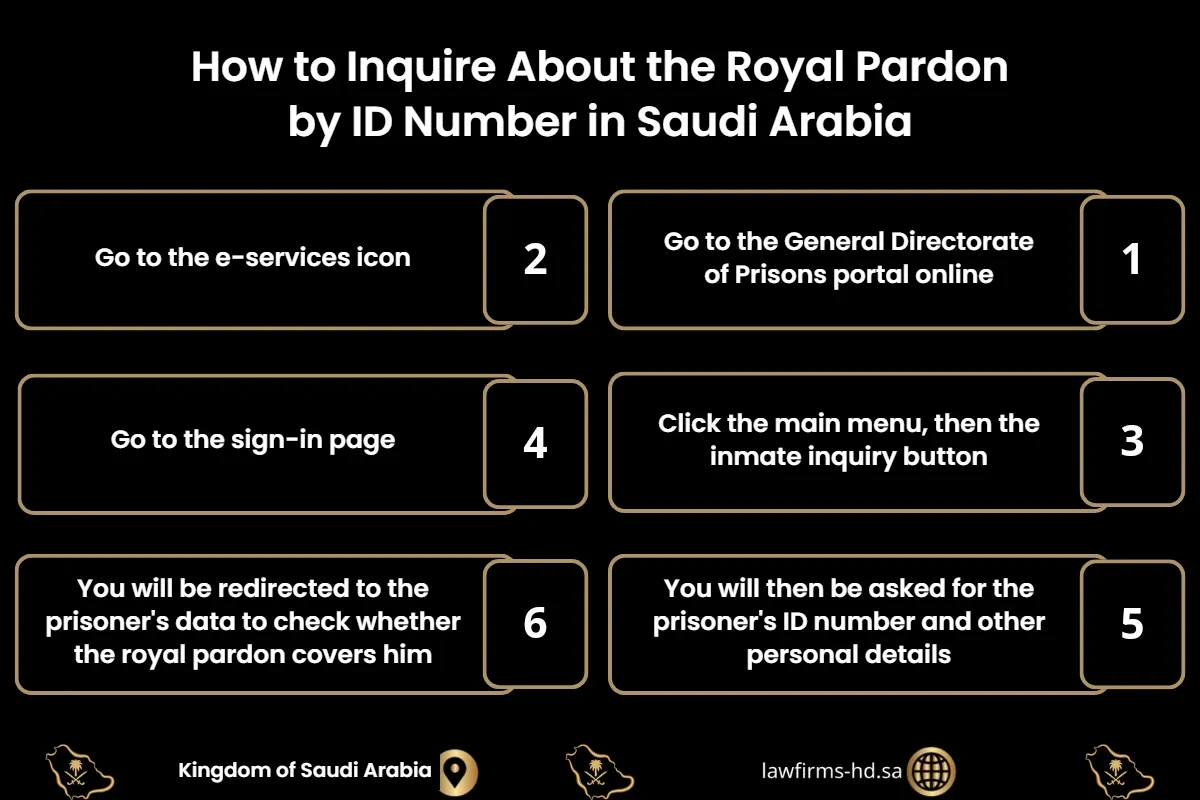
In light of this, families of prisoners can inquire about their relatives and the royal pardon through the electronic portal of the General Directorate of Prisons, by following these steps:
- Go to the General Directorate of Prisons inquiry portal online.
- Go to the e-services icon.
- Click the main menu, then the inmate inquiry button.
- Go to the sign-in page.
- You will then be asked for the prisoner’s ID number and other personal details.
- You will be redirected automatically to the prisoner’s data to see whether he is among those covered by the royal pardon or not.
Are you asking about how to request a pardon or a reconsideration in Saudi Arabia?
Royal Pardon Inquiry via Absher
If you wish to apply to be covered by the royal pardon, this is possible through the Absher e-platform, as follows:
- Sign in to the Absher e-platform.
- Click the Absher Individuals option.
- Sign in using the required information.
- Submit a request to benefit from the pardon.
- Enter the required information and data.
- Click the submit request button.
How Do I Know Whether the Pardon Covers Me in Saudi Arabia?
Once the generous royal order granting a pardon to prisoners is issued, an annual procedure that embodies the values of mercy and justice, the competent committees at the General Directorate of Prisons and the Public Prosecution carefully review the inmates’ files.
To verify whether you or your relatives are covered by the pardon, you should follow this regulatory path:
- Direct digital inquiry: You can inquire using the national ID number or residence (iqama) number through the General Directorate of Prisons portal or the Absher (Individuals) platform, as the data of covered inmates is updated gradually once the committees finish examining their files.
- Distinguishing between the public and private right: It must be understood that the royal pardon waives only the “public right” (the State’s right), while the “private right” (the victim’s right to compensation or blood money) remains pending and is waived only by an official waiver from the right holder.
- Excluded crimes: The pardon does not cover serious crimes that affect public security, torture of children, trafficking, premeditated murder, or crimes excluded by specific sovereign decisions to safeguard social stability.
- Application mechanism: If the name does not appear electronically even though the conditions are met, a “request to benefit from the pardon” can be submitted through the Absher platform, attaching the basic data (case number, judgment number, and the prisoner’s details).
Conditions of the Royal Pardon
Some conditions must be met by the prisoner to be covered by the pardon. There are four conditions, as follows:
- The prisoner must have served half of the sentence imposed at the time the royal pardon was issued.
- Proven good conduct throughout the period of serving the sentence.
- The prisoner must not have reoffended.
- Most importantly, the crime must be one of those covered by the royal pardon.
Does the pardon cover harassment cases?
The categories covered by the royal pardon are:
- Elderly prisoners, men and women: the royal pardon set the age at 60 for men and 50 for women.
- Prisoners who have disabilities, serious illnesses or chronic diseases.
- The crime being one of those covered by the royal pardon.
- Divorced non-Saudi women deserve the royal pardon.
- Cases related to parental disobedience, although the pardon requires that the parents’ right be collected first.
- Minor prisoners who have not exceeded 18 years of age.
Does the pardon cover theft cases in Saudi Arabia?
Specific conditions apply to some crimes. For example, the crime of drug use is covered by the pardon in cases of possession for personal use up to the fourth time. Promotion is covered for the first time only. Pickpocketing is covered provided the private right has ended and there is no previous record of it. The same applies to the crime of issuing a check without sufficient funds.
Documents Required for the New Saudi Royal Pardon Inquiry 1447 AH
The process of inquiring about the royal pardon by ID number in the Kingdom of Saudi Arabia requires a set of basic documents and data that ensure accurate access to the information and fast processing of the request by the competent committees. These requirements mainly include the following:
- National ID number or residence (iqama) number: the primary number used to verify the identity of the person concerned in government systems.
- Case number or court judgment number: this helps the competent authorities, such as the General Directorate of Prisons and the Public Prosecution, to quickly reach the case file and review whether it falls within the controls of the royal pardon issued.
- Data of the prisoner or the convicted person: the full name and civil registry number, to ensure the data matches the official records and to avoid any overlap of information.
- Power of attorney or proof of kinship: if the inquiry is made by a relative rather than the case owner, the security authorities may ask for proof of kinship or an official authorization to safeguard data privacy and the confidentiality of procedures.
It is always advisable to rely on the approved official channels, such as the Absher platform or the General Directorate of Prisons portal, to make these inquiries, noting that data updates may take some time after the royal order is issued so that the committees formed for this purpose can complete their examination.
Legal Guidelines When Inquiring About the Royal Pardon
To ensure accuracy and avoid any procedural obstacles or misleading information, the “Saudi Legal Consultation Directory” advises following these guidelines, derived from the regulations in force in the Kingdom:
- Relying exclusively on official platforms: All inquiries must be made through approved government channels only, such as the “Absher” platform or the “General Directorate of Prisons” portal, to ensure the reliability of the data and protect the prisoner’s privacy.
- Distinguishing fundamentally between the public and private right: remember that the royal pardon usually covers the “public right” (the State’s right), while the “private right” (the right of individuals or victims) remains and is waived only by an official waiver or by fulfilment; so make sure of the position of the case regarding private rights.
- Following the updates of the technical committees: the issuance of the royal order is the start of the procedural path, as all files undergo careful review by committees formed from the Prisons and the Public Prosecution to verify that the conditions apply, which may take some time before the results appear electronically.
- Organizing the case data in advance: it is preferable to have the case number, the ID number and the details of the court judgment ready before starting the inquiry, to ensure results match accurately and to avoid overlapping information.
- Obtaining a specialized legal assessment: in cases involving several overlapping judgments or excluded cases, it is preferable to get a consultation from a licensed lawyer in Saudi Arabia to assess the prisoner’s eligibility to benefit from the pardon under the new controls.
To learn about the role of the committee for pardoning public-right prisoners, or the effect of a prior record after the sentence ends in rehabilitation in drug cases, see the dedicated guides for each.
Our Role in Guiding You Toward the Correct Legal Procedure
The Saudi Legal Consultation Directory organizes your access to accurate regulatory information and simplifies the procedures followed in the Kingdom. We mainly help you understand the practical steps for inquiring about the royal pardon, and we explain the conditions, regulations and instructions related to it in simple and clear language.
Our goal is to be the right starting point that lets you understand your legal position and directs you with confidence to the competent official platforms.
And when your case requires an accurate legal assessment or a specialized study of whether you are covered by the pardon, we move with you to the stage of professional support, where we connect you with a licensed, experienced lawyer who suits the nature of your case.
This connection is made professionally to protect your privacy: the platform guides you and provides the necessary knowledge content, while the partner lawyer provides the specialized consultation required to keep you on the correct regulatory path.
Frequently Asked Questions
How can I confirm that a prisoner is covered by the pardon?
You can confirm whether a prisoner is covered by the pardon by signing in to the General Directorate of Prisons portal and choosing the inmate inquiry service. You can also ask the prison administration, or go through a lawyer who matches the judgment against the text of the decision.
Does the royal pardon cover foreigners?
Yes, the royal pardon often covers both Saudis and expatriates in public-right cases that fall within the pardon, provided the specified conditions are met and the type of crime is not excluded. Determining the position accurately depends on the type of case, the person's residency status, and the judgment deed.
In conclusion, we hope we have given a sufficient answer to the question of how to know whether the pardon covers me in Saudi Arabia and how to inquire about the royal pardon by ID number.
If you find it difficult to apply for the pardon, or you need any legal consultation on this matter, on a royal pardon inquiry or on anything else, do not hesitate to contact the Saudi Legal Consultation Directory through the Contact Us page, and we will help you obtain legal consultations in Saudi Arabia.
You can also read:
Sources:
- The Basic Law of Governance.
- General Directorate of Prisons portal.
Content is prepared and reviewed by a legal editorial team specialized in simplifying laws, regulations and legal procedures in the Kingdom of Saudi Arabia. The team relies on official statutory sources and reviews content periodically to ensure accuracy and keep pace with regulatory updates. The platform aims to spread legal awareness and facilitate access to legal information, and does not provide legal representation or law firm services in its name.