
A delay penalty in Saudi Arabia is one of the legal issues that raise many questions for individuals, companies and parties contracting with government entities, especially when contracts are performed late, financial obligations are paid late, or some official documents are renewed late.
Not knowing the rules that govern delay penalties may lead to bearing additional amounts or losing the chance to object to a penalty that is not due. In this guide, we explain what a delay penalty means in Saudi Arabia, the legal basis that governs it, its main types in contracts, taxes, residency and the national ID, how it is calculated and how it differs from a penalty clause, and the cases that may call for a specialized lawyer and a legal consultation.
Have you been asked to pay a delay penalty, or do you want to add one to a contract and fear it may not be valid under the law? Do not deal with the clause or the claim before understanding its basis. “Saudi Legal Consultation Directory” helps you understand when a delay penalty is accepted and when it is contested, and it can connect you with a licensed lawyer to review the contract or the claim when needed.
Table of Contents
What Is Meant by a Delay Penalty in Saudi Arabia?
A delay penalty in Saudi Arabia means the sum of money that falls due when a debtor or contracting party is late in performing its obligation within the set period, whether the obligation arises from a civil or commercial contract, a government contract, or a financial obligation regulated by a competent authority.
A delay penalty is not always calculated in one way. It may be a lump sum, a percentage of the contract value, a percentage of the value of the delayed part, or compensation assessed according to the harm caused by the delay. For this reason, one must first return to the source of the obligation: is it a private contract, a government contract, or a statutory penalty imposed by a competent authority? Nor is mere delay always enough to give rise to compensation in every case; the debtor or contracting party may be excused if it proves that the delay was due to a cause beyond its control, such as force majeure, the other party’s fault, or an external cause that prevented performance on time.
The Legal Basis for Delay Penalties in Saudi Arabia
Compensation for delay in civil obligations is based on:
- Article 170 of the Civil Transactions Law, which provides for an award of compensation for non-performance if performance in kind has become impossible, or if the debtor has delayed until performance is no longer of use to the creditor. It also allows the creditor, when the debtor is late in performing, to set a reasonable period for the debtor, and if the debtor does not perform within it, compensation may be claimed. Compensation is not awarded if the debtor proves that the non-performance was due to a cause beyond its control.
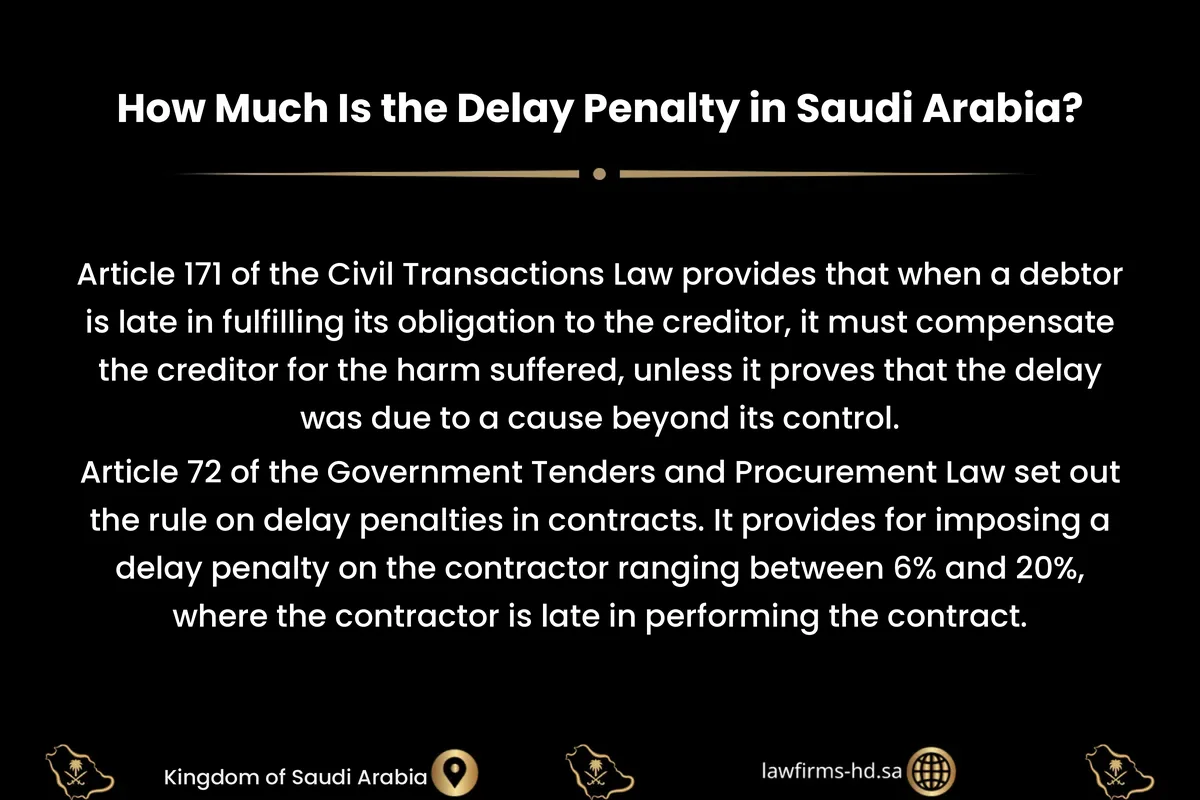
- Likewise, Article 171 of the Civil Transactions Law provides that if the debtor is late in performing its obligation, it must compensate the creditor for the harm caused by the delay, unless it proves that the delay in performance was due to a cause beyond its control. The article therefore does not make every delay give rise to an automatic penalty; instead, it ties compensation to the existence of harm and to the debtor’s responsibility for the delay.
- As for government contracts, the Government Tenders and Procurement Law devotes a chapter to penalties and contract extensions, including Article 72 on the delay penalty rate, and Article 73 on the default penalty in continuous-performance service contracts, and Article 74 on extending the contract and exemption from the penalty.
- According to Article 72, the delay penalty in government contracts is not to be framed as “from 6% to 20%” across the board. More precisely, it is subject to maximum limits that differ by contract type: it may not exceed 6% of the value of supply contracts, and it may not exceed 20% of the value of other contracts, subject to the calculation and application mechanism set by the implementing regulations and the contract documents.
Common Types of Delay Penalties in Saudi Arabia
Delay penalties in Saudi Arabia vary according to the source of the obligation and the nature of the violation. A penalty may be contractual, arising from delay in performing a contract; or statutory, imposed by a competent government authority; or a financial sanction linked to late payment of a tax or late renewal of an official document.
It is not correct to treat all delay penalties as subject to a single rule, because a delay penalty in a construction contract differs from a penalty for late payment of value-added tax, and both differ from the administrative penalties linked to residency or the national ID. For this reason, the regulating authority and the applicable law must always be identified before calculating the penalty or objecting to it.
Delay Penalty for Late Residency Renewal
The penalty for late residency renewal in Saudi Arabia is one of the administrative penalties imposed when a resident’s ID (iqama) is not renewed within the legal period after it expires.
The penalty aims to ensure that the employer or resident updates the residency status on time and avoids the resident remaining with an expired document, which may affect their legal status or their ability to benefit from some services. According to the table of violations and penalties in the Residency Law published by the Ministry of Interior, the penalty for not renewing residency on time escalates as follows:
- First time: a fine of SAR 500.
- Second time: a fine of SAR 1,000.
- Third time: a fine of SAR 1,000 together with deportation from the Kingdom, as decided by the competent authority.
It is advisable to verify the validity of the residency and renew it before it expires through official channels, because the effect of delay may not be limited to the financial penalty; it may also disrupt some procedures and services linked to residency, work and travel. It should also be borne in mind that applying the penalty or any additional measure is subject to what the General Directorate of Passports and the competent authorities decide, according to the resident’s case, record and the number of times the violation occurred.
Late-Payment Penalties for Value-Added Tax
The penalty for late payment of value-added tax in Saudi Arabia is one of the financial penalties that the Zakat, Tax and Customs Authority imposes on taxpayers who do not pay the tax due within the prescribed legal period. This penalty is among the most important penalties linked to tax delay; it equals 5% of the value of the unpaid tax for each month, or part of a month, in which the tax remains unpaid.
This means that being late even for part of a month may result in the penalty being calculated in accordance with the Authority’s established rules. A distinction must be made here between the late-payment penalty and the penalty for failing to submit the tax return. The first relates to not paying the tax due on time, while the second is imposed when the return is not submitted within the legal period, and is not less than 5% and not more than 25% of the value of the tax that should have been declared.
Other violations, such as submitting an incorrect tax return or cases of tax evasion, are not delay penalties in the strict sense; they are independent tax violations with their own rules and penalties. For this reason, when discussing delay penalties, it is preferable to focus on late payment and late submission of the return, while reviewing the Authority’s notice to learn the type of violation and the reason for the penalty before paying or objecting.
Delay Penalty in Contracts
The delay penalty in contracts is among the most common forms of delay penalties in Saudi Arabia. It arises when a party to a contract is late in performing its obligation within the period set for performance or delivery, as in construction, supply, operation, maintenance and services contracts.
In private contracts, entitlement to a delay penalty or a penalty clause is generally based on what the two parties agreed in the contract, whether the compensation is a fixed amount for each day of delay, a percentage of the contract value, or a percentage of the value of the delayed part of the works. However, agreed compensation is not immune from judicial review; under the Civil Transactions Law, the court may adjust the agreed compensation if it is shown to be excessive, if part of the obligation has been performed, or if the debtor proves that the delay was due to a cause beyond its control. As for government contracts, Article 72 of the Government Tenders and Procurement Law regulates delay penalties, whereby the penalty may not exceed 6% of the value of supply contracts, nor 20% of the value of other contracts, taking into account the cases that allow extending the contract or exempting from the penalty under the provisions of the Law and its implementing regulations. A distinction must also be made between the delay penalty and the default penalty. The delay penalty relates to exceeding the period set for performance or delivery, while the default penalty relates to a breach of the level of performance, work quality or the agreed services, and the two penalties may apply together in some contracts if both delay and default occur, according to the contract terms and the provisions of the Law.
Delay Penalty for Late National ID Renewal
The penalty for late renewal of the national ID is an organizational penalty linked to the expiry of the ID card and failure to renew it by the set date. The Absher platform explains that the national ID renewal service is available when 180 days or fewer remain before the ID expires, provided that the beneficiary has no unpaid penalties with the Civil Affairs sector. The national ID card is renewed every ten years, and delay in renewing it after expiry results in a financial penalty of SAR 100, as the Civil Affairs explained in its awareness statements. The wording that makes the penalty graduated percentages such as 10%, 20% or 50% is therefore inaccurate. It is advisable to renew the national ID before it expires through official channels, because its expiry may disrupt some government, banking or procedural services that require a valid ID. Any penalty recorded with the Civil Affairs sector must also be paid before completing the renewal procedure, where one exists.
How Delay Penalties Are Calculated
The method of calculating a delay penalty in Saudi Arabia varies according to the source of the penalty; it may be provided for in a private contract, set in a government contract, or imposed under a tax or administrative regulation. The type of obligation must therefore be identified first before calculating the penalty. Delay penalties are usually calculated according to the following elements:
- Source of the penalty: is it stated in a private contract, in a law such as the Government Tenders and Procurement Law, or issued by a competent authority such as the Zakat, Tax and Customs Authority, the Passports or the Civil Affairs?
- Value of the obligation: the penalty may be calculated on the entire contract value, on the value of the delayed part only, on the amount of unpaid tax, or as a fixed amount set by the competent authority.
- Period of delay: it usually starts from the day after the performance, payment or renewal period ends, and continues until the actual date of performance, payment or acceptance of delivery, unless there is an extension or exemption.
- Specified percentage or amount: the penalty may be a daily amount, a percentage of the contract value, 5% per month in some tax penalties, or a fixed amount as in some administrative penalties.
- Maximum penalty: in government contracts, the delay penalty may not exceed 6% of the value of supply contracts, nor 20% of the value of other contracts, under Article 72 of the Government Tenders and Procurement Law.
- Grounds for exemption or reduction: the penalty may not be due, or may be reduced, if force majeure, a cause beyond the debtor’s control, the other party’s fault, or an official extension of the performance period is proven.
Reviewing the delay penalty clause before signing the contract is important, because clarity about the percentage, the start of calculation, the maximum limit and the cases of exemption reduces disputes during performance.
The Difference Between a Delay Penalty and a Penalty Clause
Some people confuse the delay penalty with the penalty clause, although the relationship between them is not one of complete identity. A delay penalty is usually linked to exceeding the set date for performing the obligation or delivering the work, whereas a penalty clause is an advance agreement between the parties to the contract on the amount of compensation for breach of the obligation, whether the breach is due to delay, non-performance or non-conforming performance. The following table shows the main differences between them:
| Point of comparison | Delay penalty | Penalty clause |
|---|---|---|
| Meaning | An amount that usually falls due when performance of the obligation is delayed beyond the set period | Agreed compensation that the contracting parties set in advance for breach of the obligation |
| Ground for entitlement | Exceeding the performance or delivery period | Any breach stated in the contract, such as delay, non-performance or non-conforming performance |
| Scope of application | Appears often in construction, supply, operation and government contracts | Appears in various civil and commercial contracts whenever the parties agree to it |
| How it is determined | May be set by the contract or the law, as in government contracts subject to the Government Tenders and Procurement Law | Set by agreement of the parties in the contract or its annexes |
| Court’s authority | The court examines the reason for the delay and whether the penalty is due when there is a dispute | The court may adjust the agreed compensation under the Civil Transactions Law if grounds are established |
| Relationship between them | A delay penalty may be a form of penalty clause if the parties agreed on it in the contract | Broader than the delay penalty, because it may cover delay and other forms of breach |
Accordingly, every delay penalty stated in a private contract may be treated as a penalty clause if it was determined in advance between the parties, but not every penalty clause relates to delay; a penalty clause may be set for non-performance, breach of an essential condition, breach of confidentiality, or termination of the contract without a legitimate reason. The default penalty differs from both; it appears mostly in some government contracts and continuous service contracts when the level of performance, quality of service or agreed specifications are breached, and it is not merely a delay in performance.
When Do You Need a Lawyer in Delay Penalty Cases?
Not all delay penalties call for a lawyer, but the need grows when the amount of the penalty is high, when there is a dispute over the reason for the delay, or when the penalty is linked to a construction or supply contract, a government project or a large financial claim. Cases in which a legal consultation is advisable include:
- Objecting to a delay penalty imposed under a contract or an administrative decision.
- Reviewing whether the penalty has been calculated correctly and within its legal limits.
- Studying whether a penalty clause is due or whether it can be reduced.
- Proving that the delay was due to a cause beyond the contracting party’s control.
- Reviewing construction, supply and operation contracts before signing them.
- Negotiating the settlement of a dispute relating to delay penalties.
- Representing legal interests in contractual or commercial disputes when needed.
How Does the Saudi Legal Consultation Directory Help You?
Saudi Legal Consultation Directory is an educational platform that aims to simplify legal rules and procedures; it is not a law firm and does not represent clients before the courts. We help you understand the legal aspects of delay penalties, penalty clauses and contractual obligations through documented and simplified legal content. The platform can help you with:
- Clarifying the difference between a delay penalty and a penalty clause.
- Explaining the laws and procedures relating to contracts and financial claims.
- Clarifying the objection and grievance routes available under the law.
- Helping you understand contract terms before taking any step.
- Directing you to a suitable licensed lawyer when you need a specialized consultation or legal representation.
If you have a particular case or dispute relating to a delay penalty or a penalty clause, you can request a general consultation through the platform to understand the legal options available and make the right decision based on the circumstances of your case.
Frequently Asked Questions
What is the difference between a delay penalty and a penalty clause?
A delay penalty relates to being late in performing an obligation or delivering work within the set period, whereas a penalty clause is agreed compensation that the two parties set in advance for any breach of the contract, whether due to delay, non-performance or defective performance. A delay penalty may therefore be a form of penalty clause if it is stipulated in the contract, but a penalty clause is broader in scope and is not limited to cases of delay.
What is the ruling on a delay penalty for late payment of instalments?
Stipulating a financial increase on a loan because of late repayment is a void condition under Article 385 of the Civil Transactions Law, because it results in an increase in the repayment of the loan. It is therefore not permissible to agree on a delay penalty that represents an increase over the principal debt or loan in return for delay in repaying it.
How is a delay penalty calculated in Saudi Arabia?
A delay penalty in Saudi Arabia is calculated according to the contract or the law governing the obligation; it may be a percentage of the contract value or of the delayed part, a percentage of the amount due, or a fixed amount set by the competent authority. Not all delay penalties depend on the number of days of delay, as the method of calculation differs according to the nature of the penalty and the contract or law applied.
Sources:
Content is prepared and reviewed by a legal editorial team specialized in simplifying laws, regulations and legal procedures in the Kingdom of Saudi Arabia. The team relies on official statutory sources and reviews content periodically to ensure accuracy and keep pace with regulatory updates. The platform aims to spread legal awareness and facilitate access to legal information, and does not provide legal representation or law firm services in its name.
Similar Articles:
 Sample Release for Receipt of All Dues in Saudi Arabia and Its Legal Conditions
 What Is Ta’zir in Private Right in Saudi Arabia? Conditions and Penalties
 Checking for a Travel Ban Because of a Case in Saudi Arabia: Your Complete Guide
 Implementing Regulations of the Narcotics Control Law in Saudi Arabia and Their Key Provisions