
Article 70 of the Enforcement Law is one of the provisions that raises the most questions when enforcement decisions are issued, especially when it comes to seizure, fines, or even imprisonment. Many people find it hard to understand when this article applies, what the limits of the enforcement judge’s powers are, and whether imprisonment is an immediate measure or goes through stages.
In this article you will get a clear explanation of Article 70, when Enforcement Decision 70 applies, and the sequence of the procedures set out in the Enforcement Law, along with the practical cases linked to it and when you need legal advice.
Table of Contents
What Is Article 70 of the Enforcement Law?
Article 70 of the Enforcement Law in Saudi Arabia concerns direct enforcement where an obligation cannot be carried out by the competent force, or where a financial fine is imposed on the judgment debtor and he continues to refuse to comply within the period set by the enforcement judge.
In this case, the Law allows the enforcement judge to issue an order imprisoning the judgment debtor to compel him to comply. So the article does not deal with all kinds of enforcement debts in general; it falls under direct enforcement, where imprisonment is a means of compelling a person who refuses to perform an obligation that is still possible and still required of him.
Text of Article 70 of the Enforcement Law
The text of Article 70 is:
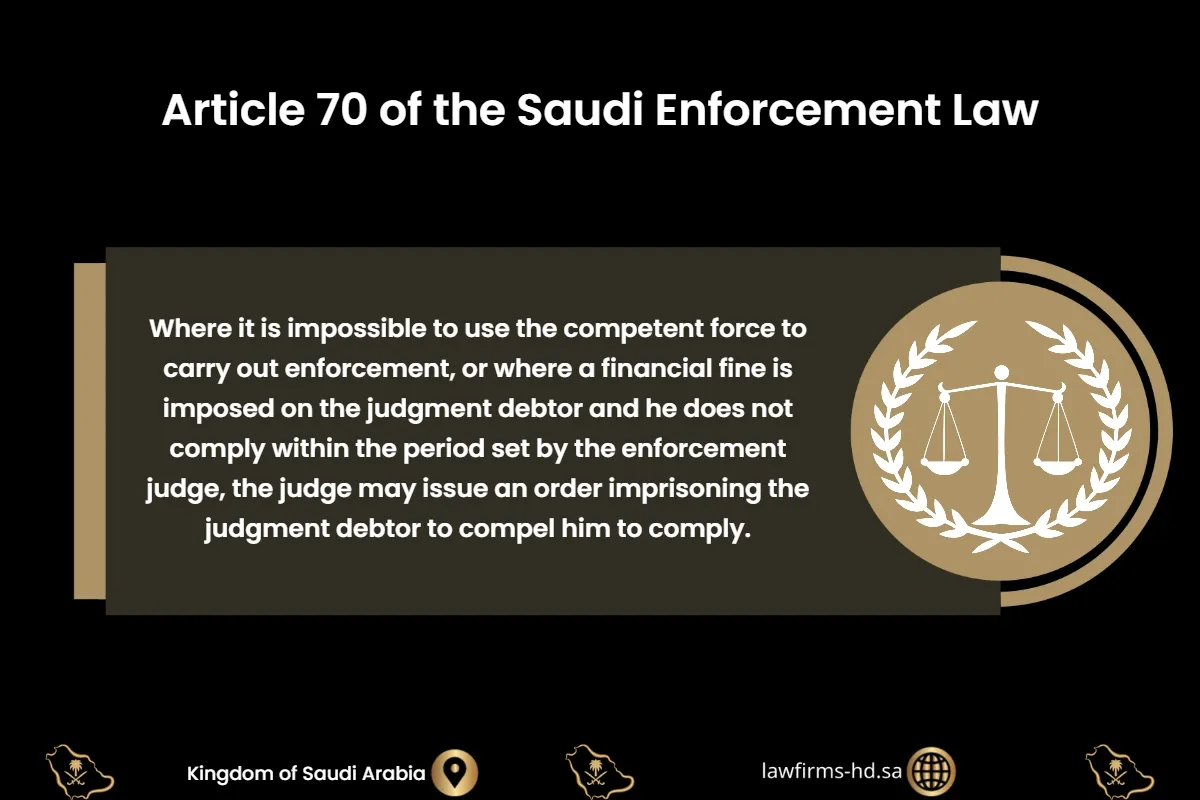
Where it is impossible to use the competent force to carry out enforcement, or where a financial fine is imposed on the judgment debtor and he does not comply within the period set by the enforcement judge, the judge may issue an order imprisoning the judgment debtor to compel him to comply.
This text shows that the imprisonment ruling under Article 70 has two clear cases:
- First: it is impossible to use the competent force to carry out enforcement.
- Second: a financial fine is imposed on the judgment debtor, who then does not comply within the period set by the enforcement judge.
The text also uses the phrase “may”, which indicates that imprisonment here is at the discretion of the enforcement judge within the scope of this article, and is not automatic in every case.
Do you know what is provided in:
When Is Article 70 of the Enforcement Law Applied?
Article 70 applies when the subject of enforcement is an act or an abstention from an act, and the judgment debtor is ordered to comply but does not do so within the statutory period, so that the direct enforcement provisions that precede it begin to apply first.
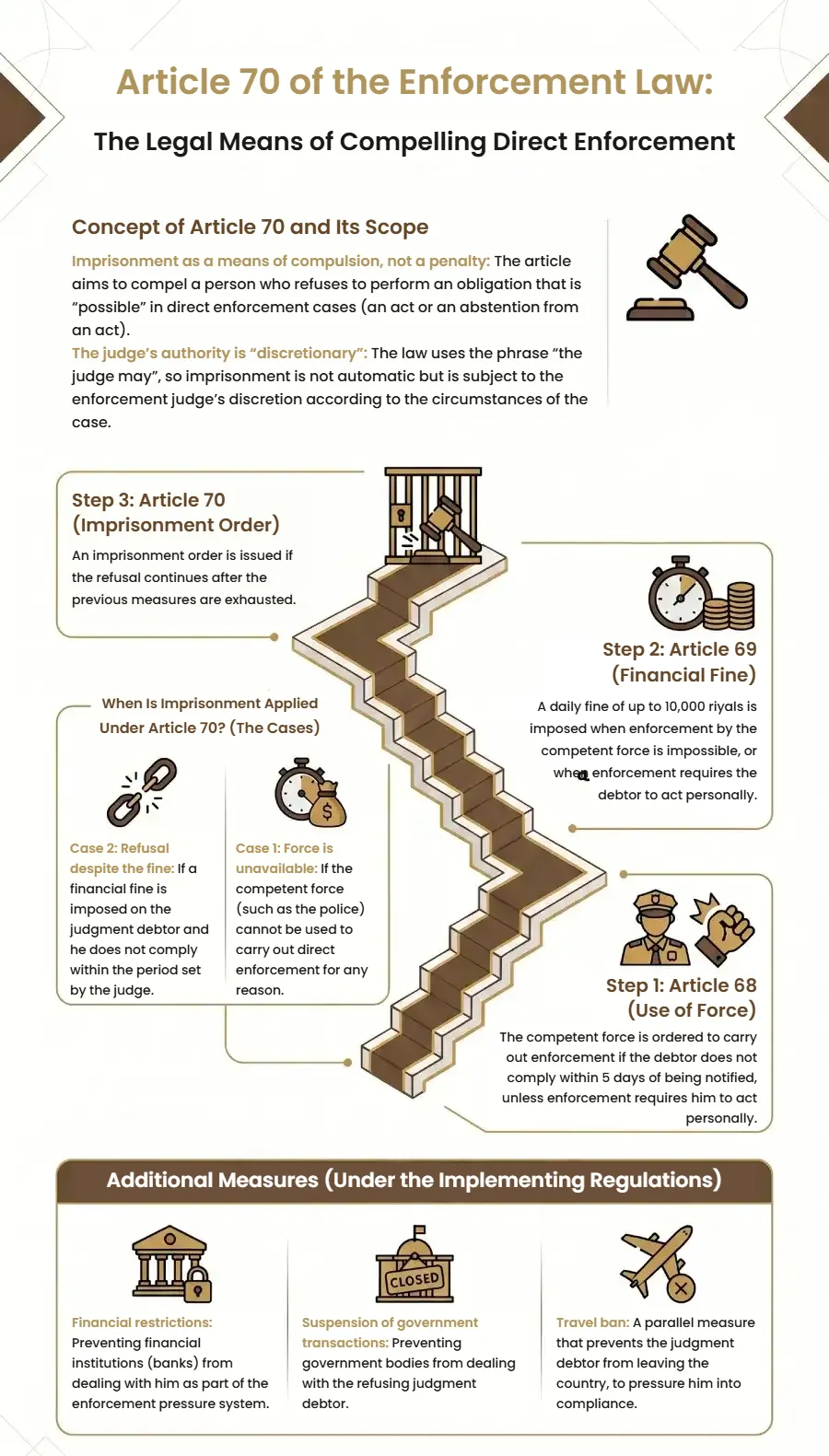
Article 68 of the Enforcement Law provides that where the subject of enforcement is an act or an abstention from an act and the judgment debtor does not perform his obligation within five days of being notified, the enforcement judge must order the use of the competent force to carry out the necessary enforcement procedures, unless enforcement requires the debtor to do it himself.
Then Article 69 of the Enforcement Law provides for the financial fine where enforcement by the competent force is impossible, or where enforcement requires the debtor to perform it himself and he does not. After these two stages, Article 70 permits imprisonment if enforcement by the competent force is impossible, or if the fine has been imposed and the refusal continues.
What are the Jeddah Enforcement Court numbers, and what are the ways to inquire and get in touch quickly?
The Legal Context of Imprisoning a Debtor Who Refuses to Comply
The legal context of Article 70 starts from Article 68, then Article 69, then Article 70. The Law arranged the means progressively in the chapter on direct enforcement:
- First: using the competent force whenever possible.
- Second: imposing a daily financial fine of no more than ten thousand riyals where enforcement by the competent force is impossible, or where enforcement can only be done by the judgment debtor himself.
- Third: imprisonment if the refusal continues after that, as provided in Article 70.
The Implementing Regulations of Article 70 add that where the judgment debtor refuses to comply in direct enforcement, the circuit may, in addition to the procedures set out in the Law, take one or all of the following measures against him:
- Travel ban.
- Preventing government bodies from dealing with him.
- Preventing financial institutions from dealing with him.
This confirms that imprisonment under Article 70 is not the only measure, but one of the means of enforcement pressure within a wider system of statutory measures.
When is there impossibility of executing a judgment in Saudi Arabia?
Duration of Imprisonment Under Article 70
The duration of imprisonment under Article 70 is not fixed by the text of the article itself. Rather, the Law makes imprisonment a means of compelling the judgment debtor to comply when enforcement by the competent force is impossible, or when he has not complied after the financial fine.
Cases Where the Judgment Debtor May Not Be Imprisoned
Article 70 itself does not include a separate list of the cases in which imprisonment is not allowed, but it operates only within its defined scope, that is, in direct enforcement and after its conditions are met. Therefore, imprisonment is not applied under it outside this framework.
On the other hand, the Law gave the enforcement judge the authority to consider insolvency claims, and Article Three provides for his jurisdiction to order imprisonment and release and to consider insolvency claims. The later insolvency articles also contain special provisions for a person whose insolvency is proven and for verifying the insolvency claim.
Hence, the existence of an insolvency issue or an enforcement dispute that affects the progress of enforcement remains tied to the other statutory provisions in the same chapter, and must not be automatically mixed with Article 70 as if it applied in every case of refusal without regard to the remaining provisions governing enforcement.
Practical Examples
Here are some examples:
First example:
A judgment or an enforceable instrument obliges a person to vacate a site, remove an encroachment, or carry out a direct enforcement act. He is notified to comply within the statutory period but does not. If the obligation can be carried out by the competent force, enforcement begins that way under Article 68. If enforcement by this means is impossible, it may move on to the fine and then to imprisonment in the statutory sequence.
Second example:
If the subject of enforcement is an obligation that only the judgment debtor himself can perform, such as enforcement based on a personal act that a third party cannot substitute for, and he refuses to comply, the enforcement judge may impose a daily financial fine on him under Article 69. If he continues to refuse within the period set by the judge, an order imprisoning him may be issued under Article 70 to compel him to comply.
Third example:
In direct enforcement cases where the judgment debtor keeps obstructing enforcement, the matter is not limited to imprisonment alone, because the Regulations also allow preventing him from travelling, preventing government bodies from dealing with him, and preventing financial institutions from dealing with him, as the circuit sees fit. This is an important practical example showing that Article 70 works within several enforcement tools and is not separate from them.
When Do You Need Legal Advice in Direct Enforcement Cases?
You need specialist legal advice to understand your situation precisely before taking any step, especially in direct enforcement cases and the complex procedures linked to them.
- When the matter relates to direct enforcement and not merely an ordinary financial claim.
- If it is unclear whether your case falls within Articles 68, 69 and 70 of the Enforcement Law.
- Where there is a dispute over whether enforcement by the competent force is possible.
- If the obligation must be performed by the judgment debtor personally.
- If an enforcement dispute or an objection to the enforcement procedures arises.
- Where payment is claimed or there is proof that the obligation has been settled.
- If insolvency, or a dispute over the ability to comply, is claimed.
- When additional measures are issued, such as:
- Travel ban.
- Suspension of government dealings.
- Preventing dealings with financial institutions.
To learn the factors that affect the assessment of lawyer’s fees in enforcement cases, you can refer to the guide to lawyers’ fees in Saudi Arabia.
The platform’s customer service team (not a lawyer) receives your message and directs you to a licensed lawyer when needed.
How Does the Saudi Legal Consultation Directory Help You?
At the Saudi Legal Consultation Directory, we simplify the laws and explain them accurately, linking the statutory text to its practical application, to help you understand your legal position clearly before taking any step.
- Providing a simplified and accurate explanation of Article 70 of the Enforcement Law.
- Clarifying its place within direct enforcement procedures.
- Explaining the difference between:
- Using the competent force
- The financial fine
- Enforcement imprisonment
- Guiding you to understand the legal options available in your case.
- Helping you inquire about Enforcement Court cases in Saudi Arabia.
- Helping you avoid common mistakes in enforcement procedures.
If you have a special case or an existing enforcement file, you can request a consultation through the platform so that we can help and direct you to a specialist, so that you can ask a lawyer about the enforcement case.
Frequently Asked Questions
What is Enforcement Decision 70?
The decision under Article 70 of the Enforcement Law sets out the procedure to follow where the competent force cannot be used to carry out a judicial judgment, or where a financial fine is imposed on the judgment debtor and he does not comply within the set period. It also includes issuing an order imprisoning the judgment debtor as a means of compelling him to carry out the judgment and protect the rights of the affected parties.
When can the enforcement judge issue an order imprisoning the judgment debtor?
The enforcement judge can issue an order imprisoning the judgment debtor if it is impossible to use the competent force to carry out the judgment, or if a financial fine is imposed and enforcement does not take place within the set period. This measure is taken to ensure that judgments are carried out and the rights of the parties are protected.
Does imprisonment under Article 70 end once the judgment is carried out?
Yes, imprisonment ends as soon as the judgment debtor performs the required obligation, because imprisonment under Article 70 is a means of compelling enforcement and not an independent penalty in itself.
By the end of this article, you have seen that Article 70 of the Enforcement Law is one of the important statutory tools for compelling a judgment debtor to comply in direct enforcement cases, after passing through set stages that begin with using the competent force, then the financial fine, and end with imprisonment where the refusal continues. You have also learned the conditions for applying it, its legal context, and the practical cases linked to it, which helps you understand your legal position more accurately.
If you have an inquiry or a special case relating to enforcement procedures, do not hesitate to contact us through the Contact Us page, or share the article with anyone who may need this information. You can also read our other articles on the Enforcement Law for a wider and more comprehensive understanding.
The platform’s customer service team (not a lawyer) receives your message and directs you to a licensed lawyer when needed.
Are you asking about:
- The Enforcement Law before the Board of Grievances.
- Article 34 of the Enforcement Law.
- Article 83 of the Enforcement Law.
Legal notice: This content is for awareness purposes only and is not legal advice. Every case differs according to its circumstances, and the platform can connect you with a suitable licensed lawyer when needed.
Sources:
Content is prepared and reviewed by a legal editorial team specialized in simplifying laws, regulations and legal procedures in the Kingdom of Saudi Arabia. The team relies on official statutory sources and reviews content periodically to ensure accuracy and keep pace with regulatory updates. The platform aims to spread legal awareness and facilitate access to legal information, and does not provide legal representation or law firm services in its name.
Similar Articles:
 What Is Ta’zir in Private Right in Saudi Arabia? Conditions and Penalties
 Checking for a Travel Ban Because of a Case in Saudi Arabia: Your Complete Guide
 Delay Penalty in Saudi Arabia: A Comprehensive Legal Guide to Everything You Need to Know
 Implementing Regulations of the Narcotics Control Law in Saudi Arabia and Their Key Provisions