
Many people search for the meaning of ta’zir (discretionary punishment) in private right in Saudi Arabia when they have suffered harm from a crime or want to know their rights and the procedures for claiming them before the competent court. The importance of this topic grows because of its link to the victim’s private right and the legal effects that follow from it, which differ from those of the public right and the other penalties prescribed in Saudi regulations.
In this guide, we review the concept of ta’zir in private right, the cases in which it is requested, the conditions for claiming it, the criteria for assessing the ta’zir penalty, and the main circumstances that may affect the private right, in addition to clarifying the difference between ta’zir, compensation and retribution (qisas) under Saudi regulations.
Do you have a criminal case or a private-right claim and don’t know the difference between ta’zir, compensation and the effect of waiver? Don’t let the terminology confuse your position. “Saudi Legal Consultation Directory” can help you and can connect you with a licensed lawyer.
Table of Contents
What Is Ta’zir in Private Right?
In private right, ta’zir means:
A discretionary punishment imposed because of an act that gave rise to a private right for the victim, while the injured party keeps the right to claim what is due to them as a result of the crime through the legal procedures. This does not mean that the private right itself is the punishment; rather, it is an independent right of the victim, which the victim claims before the competent court.
And Article Sixteen of the Law of Criminal Procedure provides that the victim, or whoever acts on the victim’s behalf, or the victim’s heir after them, has the right to bring the criminal case in cases involving a private right and to pursue it before the competent court. Article One Hundred and Forty-Seven also provides that anyone harmed by the crime, or their heir after them, may claim their private right before the court hearing the public criminal case.
The victim cannot determine the ta’zir penalty themselves; rather, the victim presents the claim, the requests and the evidence, and then the court rules on the case in accordance with the established facts and the applicable legal provisions. In some cases, a claim may arise for ta’zir of the offender in return for the private right, alongside the ruling on the public right, depending on the nature of the incident and what is proven before the court.
It is necessary to distinguish between the private right and the public right, since the private right concerns what the victim claims because of the harm suffered, while the public right concerns the public interest and the general criminal case. For this reason, waiving the private right does not in every case end the public case, and the effect varies according to the type of crime and the legal provisions applied to it.
Do you know when the private right lapses in Saudi Arabia?
When Is Ta’zir Requested?
Ta’zir in private right is requested when the crime causes direct personal harm to the victim or the victim’s heirs, and they have the right to claim before the competent court alongside any public right that may arise from the incident. The scope of the claim varies according to the nature of the crime, the resulting harm and the circumstances of each case.
Among the most prominent cases in which a private-right claim may arise:
- Crimes of assault on the person and the injuries or bodily harm that result from them, where retribution (qisas) is not established or is not demanded by those entitled to it.
- Crimes of insult, verbal abuse and slander that do not warrant a hadd penalty, and the resulting damage to reputation or dignity.
- Crimes of threats or harassment that cause personal harm to the victim.
- Crimes of causing harm in its various forms, whenever they result in material or moral damage.
- Crimes of defamation, publishing offensive content, or violating privacy, where they cause harm specific to the victim.
- Crimes of fraud, breach of trust or seizure of rights, whenever they cause personal harm that the injured party seeks to have redressed.
- Crimes of destruction of, or assault on, private property and the direct damage that results from them.
The assessment of whether ta’zir is deserved, and of the type of penalty or the effect that follows from the crime, remains within the jurisdiction of the competent court after it studies the facts, the evidence and the requests submitted in the case.
Conditions for Claiming Ta’zir in Private Right
A private-right claim is accepted only if conditions are met that justify the claimant’s interest in bringing the case and enable the court to hear and decide it. The most prominent of these conditions are:
- Existence of harm that is direct and personal: the claimant must have suffered physical, financial or moral harm as a result of the crime.
- Standing in the case: the claim must be brought by the victim, by someone who legally represents the victim, or by the victim’s heirs in the cases established by sharia and regulations.
- Existence of evidence or indications supporting the claim: such as documents, testimony, reports or other accepted means of proof.
- Existence of a causal link between the act and the harm: so that the harm claimed results directly from the act attributed to the defendant.
- An express claim before the competent court: the court does not examine the private right on its own initiative unless the right-holder submits a request in accordance with the legal procedures.
- Absence of a valid settlement or waiver that ended the private right: if waiver of the private right or settlement is established in accordance with legal rules, this may end the claim for the private right within the scope covered by the settlement or waiver.
Criteria for Assessing the Ta’zir Penalty
The ta’zir penalty in private-right cases is not assessed automatically. Rather, the court studies the circumstances of the incident, the degree of harm and the evidence presented, then chooses the appropriate sanction within the limits set by sharia and the relevant regulations. The most prominent criteria that may affect the assessment of the penalty are:
- Gravity of the act: the court looks at the seriousness of the conduct at issue, and whether it was physical, verbal or financial assault, or an attack on reputation and dignity.
- Extent of the harm suffered by the victim: the effect of the crime on the injured party is taken into account, whether the harm is physical, financial, moral or social.
- Strength of the evidence and proof of the incident: the penalty is not based on a mere allegation, but on the evidence and recognized indications established before the court.
- Intent and purpose: the court distinguishes between an intentional act and one resulting from mistake, impulse or poor judgment, where this affected the incident.
- The defendant’s criminal record: a prior record may affect the assessment of the penalty, especially if it relates to similar conduct.
- The defendant’s conduct after the incident: an apology, removal of the harm, an effort to reach a settlement, or compensation may be taken into account within the circumstances of the case.
- Circumstances of time and place: the fact that the act took place in a public place, a workplace or a public means of publication may affect the assessment of the act’s gravity.
- The relationship between the parties: the court may take into account the nature of the relationship between the offender and the victim, such as an employment, kinship or trust relationship, where it affects the assessment of the act’s seriousness.
- The means used to commit the act: the gravity of the act differs if it was carried out through technical means, public dissemination, or tools that increased the harm.
Based on these criteria, the ta’zir penalty may differ from one case to another, and may be imprisonment, a fine or another penalty provided for in the relevant regulations, depending on the type of crime, its proof and its circumstances.
Types of Ta’zir Penalties
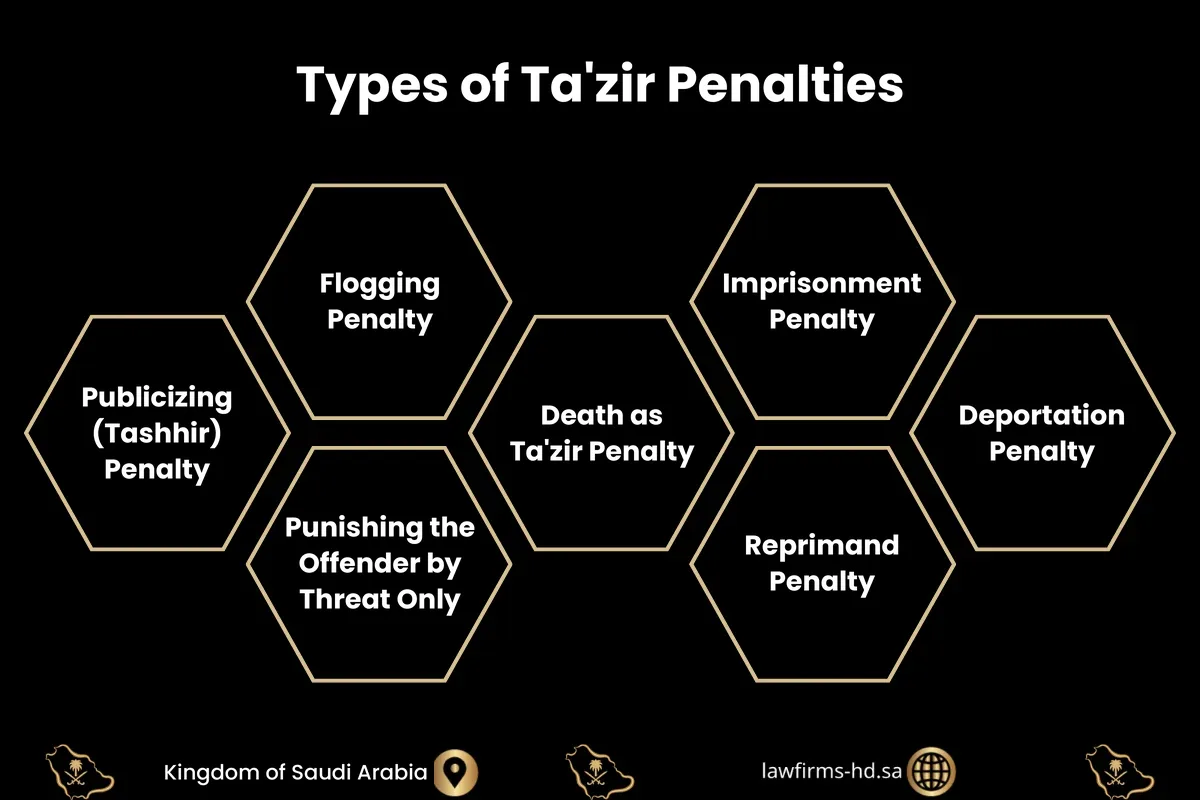
Ta’zir penalties in Saudi Arabia are not uniform for all crimes; rather, they differ according to the nature of the crime, its circumstances and the provisions of the relevant regulations. The judge has discretionary authority to choose the appropriate penalty within the limits set by sharia and regulations, in a way that achieves deterrence, reform and the protection of rights.
Forms of Ta’zir
Among the most prominent ta’zir penalties that the court may impose:
- Imprisonment: one of the most common ta’zir penalties in crimes that call for deterrence or the protection of society.
- Financial fine: imposed in many crimes, alone or alongside other penalties, as the regulation provides.
- Publicizing the ruling (tashhir): in cases where the regulations permit publishing or announcing the ruling to achieve general deterrence.
- Confiscation: including confiscation of tools, funds or proceeds linked to the crime in the cases the regulation permits.
- Deportation of non-Saudis: ordered in some crimes in accordance with the regulations in force and after the principal penalty has been served, where legally permissible.
- Prohibition from practicing an activity or a particular profession: in some crimes linked to the conduct of business, professional or commercial activities.
The ta’zir penalty differs from one case to another according to the gravity of the act, the harm resulting from it and the circumstances surrounding the incident. Each case is therefore subject to the court’s assessment in light of the evidence and the regulations applied to it.
Circumstances That May Affect the Private Right or the Ta’zir Case
The effects of the private right in ta’zir cases vary according to the nature of the crime, the stage of the case and the regulations applied to it. There is no single rule that applies to all cases, but there are circumstances that may affect the claim for the private right or the assessment of the ta’zir penalty, the most prominent of which are:
- Waiver of the private right: if the victim or the victim’s heirs waive their private right in accordance with legal procedure, the private right may end, or this may affect the case, depending on the nature of the crime.
- Settlement between the parties: settlement is one of the reasons that may end the dispute relating to the private right, provided it is made validly and is legally recognized.
- Special pardon or general pardon: some pardon orders may have legal effects that vary according to the conditions and scope of the pardon and whether it covers the public right or is limited to the penalty.
- Death of the accused: personal penalties lapse upon the death of the convicted person, while financial rights or obligations that pass to the estate remain, in accordance with sharia and regulatory provisions.
- Failure to prove the crime or insufficient evidence: if the incident is not proven or the court is not convinced by the evidence presented, no ta’zir penalty is imposed in the first place.
- Compensation, removal of the harm and efforts to settle: the court may take these circumstances into account when assessing the penalty or examining the case, according to the circumstances of each case.
It should be noted that waiving the private right or settlement does not necessarily lead to the lapse of the public right, since the competent authorities and the court retain the power to consider continuing the public case when the public interest so requires.
The Importance of Hiring a Lawyer in Private-Right Ta’zir Cases
Private-right ta’zir cases may carry important consequences relating to conviction, penalty or proof of harm. Handling these cases therefore requires a precise understanding of criminal procedure, the rules of evidence and legal defenses. The way the facts and evidence are presented before the court may also have a direct effect on the course and outcome of the case. Among the most prominent tasks in which a lawyer can help:
- Studying the facts and assessing the legal position before filing the case or responding to it.
- Identifying the appropriate evidence to prove the private right, or challenging the evidence presented.
- Preparing the statement of claim or legal memoranda in proper legal form.
- Representing the client before the competent authorities and the court.
- Following up settlement or waiver procedures and their legal effects.
- Submitting legal defenses and objections when needed.
- Following up appeal procedures and objections to judgments.
How Does the Saudi Legal Consultation Directory Help You?
The Saudi Legal Consultation Directory aims to simplify the legal concepts and judicial procedures related to private-right and ta’zir cases, by providing awareness content based on Saudi regulations and official sources in clear and understandable language. Through the platform, you can learn about the conditions for claiming a private right, the procedures for filing a case, the effect of settlement or waiver, and the difference between private right and public right, in addition to viewing the related templates and legal articles. If you have a particular situation that needs legal study or practical application to specific facts, you can request a general consultation so that we can connect you with a licensed lawyer suited to the nature of the case.
Frequently Asked Questions
What is the ruling on ta'zir in drug offences?
Under the ruling on ta'zir in drug offences, a person is punished with death as a ta'zir penalty if he smuggles narcotic drugs and psychotropic substances, receives them from a smuggler, or imports, brings in, manufactures, exports or cultivates them, or promotes them for the second time by gifting, distributing or selling.
What is the limit of ta'zir in Saudi Arabia?
There is no fixed limit for ta'zir in Saudi Arabia; it is discretionary, taking into account the circumstances of the crime and of the offender, but it is bound by the controls of Sharia and the regulations, and it must not be so severe as to exceed what is bearable under Sharia or the regulations.
What is the ta'zir penalty under Saudi law?
A ta'zir penalty in Saudi Arabia is a penalty that is not fixed under Sharia as a hadd or qisas, which the competent court imposes on the offender in ta'zir crimes in accordance with Sharia and the regulations in force. It may take the form of imprisonment, a fine, public exposure or other penalties permitted by the regulations, depending on the type and circumstances of the crime.
What is the difference between ta'zir and qisas?
Qisas is a penalty prescribed for specific crimes when their Sharia conditions are met, whereas ta'zir relates to crimes or acts whose penalty is not a hadd or qisas in the same way, and whose penalty is determined in accordance with Sharia and the regulations applicable to the incident.
Is ta'zir the same as private right?
No. Ta'zir relates to the penalty imposed for a crime, whereas private right relates to the right of the victim or injured party to claim his right arising from the crime. The public right, the private right and the ta'zir penalty may coexist in a single case, depending on its nature.
A review of the provisions on ta’zir in private right in Saudi Arabia shows that claiming a private right is a legal means of protecting the rights of injured parties and enabling them to present their claims before the competent court according to the procedures set out in the regulations. The effects of the private right and of ta’zir penalties also vary according to the nature of the crime, the evidence presented and the circumstances surrounding each case.
If you have a particular situation relating to claiming a private right or to criminal case procedures, you can benefit from the awareness content on the Saudi Legal Consultation Directory, or request a general consultation through the Contact Us page so that we can connect you with a licensed lawyer suited to the nature of your case. Get more information about:
- The limitation period for the private right.
- The penalty for a malicious lawsuit under Saudi regulations.
Sources:
Content is prepared and reviewed by a legal editorial team specialized in simplifying laws, regulations and legal procedures in the Kingdom of Saudi Arabia. The team relies on official statutory sources and reviews content periodically to ensure accuracy and keep pace with regulatory updates. The platform aims to spread legal awareness and facilitate access to legal information, and does not provide legal representation or law firm services in its name.
Similar Articles:
 Sample Release for Receipt of All Dues in Saudi Arabia and Its Legal Conditions
 Checking for a Travel Ban Because of a Case in Saudi Arabia: Your Complete Guide
 Delay Penalty in Saudi Arabia: A Comprehensive Legal Guide to Everything You Need to Know
 Implementing Regulations of the Narcotics Control Law in Saudi Arabia and Their Key Provisions