
Article 88 of the Saudi Enforcement Law is an important provision that is not about a debtor merely being late in paying. It deals with more serious situations linked to obstructing enforcement, resisting it, or circumventing court judgments. Many people confuse a debtor who is genuinely unable to pay with a debtor who deliberately hides their funds, submits incorrect information, or resists enforcement procedures.
In this article from the Saudi Legal Consultation Directory, we explain the text of Article 88, its simplified meaning, the offences it covers, and its penalty under the new Enforcement Law, with practical examples that help the reader understand the enforcement procedures followed and when conduct moves from mere refusal or delay to a serious legal violation.
Table of Contents
Text of Article 88 of the Saudi Enforcement Law
Article Eighty-Eight of the Enforcement Law states the following:
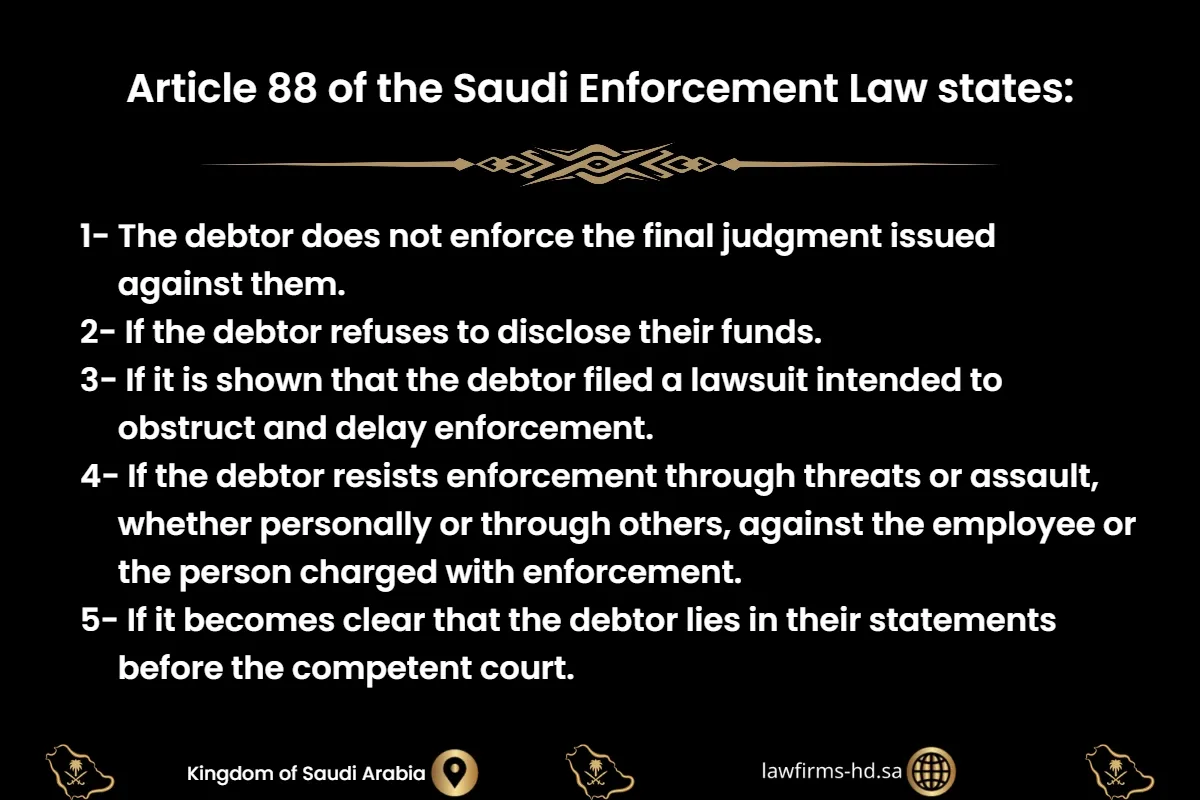
Any debtor who commits any of the following crimes shall be punished with imprisonment for a period not exceeding seven years:
- Refusing to enforce the final judgment issued against them, or being proven to have hidden or smuggled their funds, or refusing to disclose the funds they hold.
- Deliberately obstructing enforcement by filing a lawsuit intended to obstruct enforcement.
- Resisting enforcement, by threatening or assaulting, personally or through another, an employee or licensee carrying out the enforcement, or doing any of that against the enforcement creditor, and any other unlawful act done with the intent of resisting enforcement.
- Lying in their declarations before the court, or lying in the proceedings, or submitting incorrect information.
- The same penalty applies to anyone who assists or helps the debtor in any of the crimes stated in this article.
Learn about:
Article 88 of the Enforcement Law Explained Simply
In simple terms, Article 88 of the Enforcement Law in Saudi Arabia does not mean that every debtor who is late in paying is imprisoned immediately. Its scope is narrower and more specific. It does not deal with mere “debt” or “delay”; it deals with serious conduct by the debtor aimed at obstructing the enforcement of a judgment or circumventing it. This is where the essential difference that the law stresses becomes clear:
There is a difference between a person who is genuinely unable to pay a debt because of real financial hardship, and a person who has the ability or the information but deliberately hides their funds, smuggles them out, or gives incorrect information to the judicial authorities.
In other words, the law does not punish “poverty” or “inability”; it punishes bad faith and manipulation of procedures. If the debtor cooperates with the Enforcement Court, discloses their funds correctly, and shows willingness to pay within their means, they usually fall outside the scope of this article. But if it is proven that they use devious means to defeat or obstruct enforcement, this may place them under Article 88.
The article aims to protect the standing of court judgments and ensure they are enforced effectively, so that enforcement procedures do not become mere formalities that can be stalled through delay or circumvention. That is why the penalty is relatively severe: it targets not the debt itself, but the conduct that obstructs justice and harms the rights of the creditor or the enforcement creditor.
Important Note
This explanation relies on the text of Article (88) of the Enforcement Law currently in force in the Kingdom of Saudi Arabia. As for what is circulated about the new Enforcement Law, the authoritative reference when applying it is what is officially published and put into effect, so it is advisable to always refer to the updated legal text through official bodies.
How can you inquire about Enforcement Court cases in Saudi Arabia by ID number via Najiz?
What Offences Are Punished Under Article 88?
The offences stated in Article 88 are:
Refusing to Enforce the Final Judgment
This means there is a final judgment that must be enforced, and the debtor refuses to enforce it without an acceptable justification, especially if the refusal comes with conduct showing deliberateness or stalling. The mere existence of a financial claim is not enough; the nature of the judgment, the debtor’s condition, and whether the refusal was deliberate must all be considered.
Hiding or Smuggling Funds
This form is established when it is proven that the debtor hid their funds, moved them, or arranged sham transactions in order to stop the creditor from reaching them. An example is moving money or assets to a relative or another party to make oneself appear unable to pay.
Refusing to Disclose Funds
The Enforcement Law obliges the debtor to disclose their funds when the enforcement judge requests it. If the debtor refuses to state what accounts, real estate, assets, or financial rights they hold, their act may fall within the scope of Article 88 where the other conditions of liability are met.
Deliberately Obstructing Enforcement Through a Vexatious or Sham Lawsuit
The law does not prevent a person from exercising the right to litigate, but Article 88 punishes anyone who files a lawsuit not to claim a genuine right but with the intent to obstruct and delay enforcement. The difference here is subtle: a serious lawsuit is a legitimate right, while a lawsuit filed only to stall may be considered a form of obstructing enforcement.
Resisting Enforcement or Assaulting Those Carrying It Out
This offence includes threatening an enforcement employee, assaulting them, threatening the enforcement creditor, or committing any unlawful act intended to prevent enforcement procedures. It also covers using others to resist or threaten, because the text covers acts committed by the debtor personally or through another.
Lying in Declarations or Submitting Incorrect Information
This includes the debtor giving incorrect information before the court or during enforcement proceedings, such as denying funds they know exist, or giving misleading information about their income, assets, or financial dealings. Correct disclosure is one of the most important tools of the enforcement judge for reaching enforceable funds.
Learn about the cases and steps of a suspended prison sentence in Saudi Arabia.
What Is the Penalty Under Article 88 of the Enforcement Law?
The penalty set by Article 88 is imprisonment for a period not exceeding seven years, a discretionary penalty determined by the judiciary according to the facts of each case, the seriousness of the act, its effect on enforcement, and the presence of intent to obstruct, hide, or resist.
The penalty is not limited to the debtor alone; it extends to anyone who helped or assisted them in committing any of the offences stated in the article. This matters in cases where an attempt is made to smuggle or hide funds through a relative, a partner, a legal representative, or another person.
The Implementing Regulations also provide that the provisions of this article apply to the legal representative of a private legal person, or to whichever of its personnel caused the obstruction of enforcement.
Is Every Debtor Exposed to Imprisonment Under Article 88?
No, not every debtor is exposed to imprisonment under Article 88. The mere existence of a debt or a delay in payment is not enough on its own to apply this article, because the text speaks of specific offences such as hiding funds, refusing to disclose them, resisting enforcement, lying in statements, or filing a lawsuit intended to obstruct enforcement.
Therefore, a distinction must be made between an insolvent debtor or one unable to pay, and a stalling or circumventing debtor. The first may be subject to different legal procedures relating to insolvency, disclosure, or attachment, while the second may face stricter liability if it is proven that they deliberately obstruct enforcement or hide their funds.
Practical Examples of Applying Article 88
Applications of Article 88 appear in practice when the debtor’s conduct moves from mere delay in payment to deliberate acts aimed at obstructing or circumventing enforcement. The most prominent cases include:
- Moving or smuggling funds after the judgment is issued: for example, the debtor transfers their funds to other people’s accounts or registers their property in relatives’ names to appear as though they own nothing that can be enforced against, which may be considered hiding or smuggling funds.
- Giving incorrect declarations or information: such as the debtor denying ownership of assets or giving incomplete or misleading financial information before the Enforcement Court, and it later turns out that there were funds or rights they did not disclose, which falls under lying in declarations.
- Resisting or obstructing enforcement procedures: such as threatening the enforcement officer or the competent employee, preventing them from carrying out legal procedures, or using others to obstruct enforcement, conduct which the law punishes directly.
- Filing sham lawsuits to obstruct enforcement: where the debtor files a lawsuit that appears to claim a right but in reality aims to gain time and stop or delay enforcement procedures with no serious legal basis.
When Do You Need Legal Advice in Enforcement Cases?
Legal advice becomes more important in enforcement cases when legal procedures overlap with your financial responsibilities or your judicial rights, making it hard to make the right decision without a precise understanding of the law. The main cases in which legal guidance is recommended include:
- There is a judgment or an enforceable instrument and you need to collect your right: if a judgment or enforceable instrument was issued in your favor and you do not know the legal steps to start enforcement or speed up its procedures.
- An enforcement order was issued against you and you need to understand your obligations: especially regarding disclosing funds, or knowing what may be attached and what is legally exempt.
- Facing an accusation of hiding funds or giving incorrect information: one of the sensitive situations that may fall under Article 88 and needs careful legal assessment.
- Confusion between financial hardship and stalling: legal understanding helps you prove good faith and avoid legal consequences.
- The need to distinguish between enforcement procedures and penalties: such as the difference between the procedures of Article 46 and the penalty of Article 88, to avoid any act that could be interpreted as obstructing enforcement.
Send your legal question on WhatsApp. The platform’s customer service team (not a lawyer) receives your message and directs you to a licensed lawyer when needed.
How do you submit an objection to the enforcement judge’s ruling in Saudi Arabia?
How Does the Saudi Legal Consultation Directory Help You?
At the Saudi Legal Consultation Directory, we provide reliable, simplified legal content that helps you understand systems and procedures before taking any step, relying on legal texts and official sources, in clear language free of complexity.
The platform is not a law firm and does not represent parties before courts, but it gives you an accurate picture of your case’s course and helps you know when you need specialized legal advice.
If you have a special situation involving enforcement of a judgment, a dispute over disclosing funds, or the procedures of Article 46 or Article 88, you can request general advice through the Directory so that you are directed to a suitable licensed lawyer according to the nature of your situation.
Frequently Asked Questions
What does refusing to enforce a debt mean in Saudi Arabia?
Refusing to enforce a debt under Article 88 of the Enforcement Law covers the following: 1- The debtor does not disclose their funds. 2- The debtor hides their funds and smuggles them. 3- The debtor files a lawsuit intended to obstruct payment of the debt. 4- The debtor resists enforcement through threats and assault. 5- The debtor lies before the court or during the proceedings.
What is the purpose of Article 88 of the Saudi Enforcement Law?
The purpose of Article 88 of the Enforcement Law is to deter the stalling debtor who resists enforcement and works to delay it through threats or assault.
Article 88 of the Enforcement Law in Saudi Arabia shows that the law does not punish the mere existence of a debt. It focuses on conduct that obstructs the enforcement of judgments or circumvents them, such as hiding funds, giving incorrect information, or resisting enforcement procedures. This reflects the law’s concern to balance protecting the creditor’s rights with ensuring no harm comes to a debtor who commits to disclosure and cooperates with the Enforcement Court.
At the Saudi Legal Consultation Directory, we aim to provide a simplified and accurate explanation of laws and regulations that helps you understand your legal position clearly before taking any step, free of complexity or conflicting interpretations.
If you have a situation involving enforcement cases or need a more precise understanding of how Article 88 applies in your case, you can contact us through the Contact Us page so that you are directed to a suitable licensed lawyer when needed.
Are you asking about:
Have a similar case? Ask to be directed to a lawyer on WhatsApp. The platform’s customer service team (not a lawyer) receives your message and directs you to a licensed lawyer when needed.
Sources: Saudi Enforcement Law and its Implementing Regulations; Laws Portal of the Bureau of Experts at the Council of Ministers.
Disclaimer: This article is for general informational and awareness purposes only. It is not legal advice and does not create a lawyer-client relationship. The platform does not practice law.
Content is prepared and reviewed by a legal editorial team specialized in simplifying laws, regulations and legal procedures in the Kingdom of Saudi Arabia. The team relies on official statutory sources and reviews content periodically to ensure accuracy and keep pace with regulatory updates. The platform aims to spread legal awareness and facilitate access to legal information, and does not provide legal representation or law firm services in its name.
Similar Articles:
 Delay Penalty in Saudi Arabia: A Comprehensive Legal Guide to Everything You Need to Know
 Implementing Regulations of the Narcotics Control Law in Saudi Arabia and Their Key Provisions
 Procedures Under the Saudi Enforcement Law Explained
 Article 70 of the Saudi Enforcement Law: Enforcement Imprisonment Explained